Guide to Exporting Glass Bottles From China
Navigating the compl
Navigating the complexities of exporting glass bottles from China requires a strategic balance of technical compliance, advanced manufacturing, and rigorous logistics. For global beverage and cosmetic brands, securing a reliable manufacturing partner ensures product integrity and supply chain stability.
Compliance and Quality Certification
When importing glass packaging, regulatory compliance is paramount. Leading Chinese manufacturers align production with global safety benchmarks, including FDA, ISO, and SGS standards. Utilizing food-grade, lead-free glass guarantees that the packaging remains chemically inert, eliminating contamination risks for premium spirits or skincare products.
Advanced Manufacturing and Customisation
The economic viability of high-volume production in China is driven by high-speed automation. Utilizing precision Individual Section (IS) machines and computerised servo feeders, factories ensure strict dimensional accuracy 0.2 mm. This precision guarantees seamless integration with automated global bottling lines. Brands can also leverage custom decoration techniques—such as acid frosting, silk-screen printing, and hot foil stamping—to maximize shelf appeal.
International Logistics and Breakage Prevention
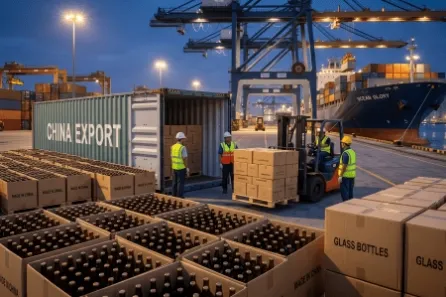
The primary challenge when exporting fragile cargo is transit damage. Professional suppliers employ a multi-layered, shock-absorbent packaging strategy:
Transit Security: Secure loading in ocean containers minimizes movement during maritime freight, ensuring safe delivery to international ports.nt within a week, custom-moulded projects typically require a total lead time of 12 to 14 weeks to account for CAD drawings, technical mould development, and final sample approval before mass production begins.
Internal Protection: High-density corrugated dividers prevent glass-on-glass friction.
Palletisation: Cartons are securely stacked on fumigated plywood pallets, reinforced with industrial stretch wrap and plastic strapping.