The Journey of Bespoke Glass Manufacturing
Bespoke Glass Manufa
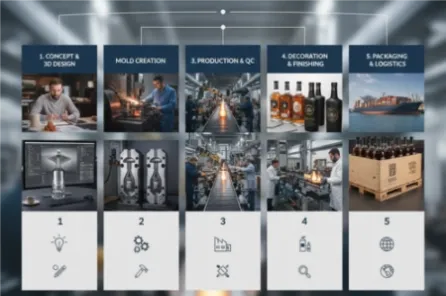
Bespoke Glass Manufacturing – Creating a bespoke glass bottle is a sophisticated engineering feat that balances creative vision with industrial precision. For brands seeking to differentiate themselves, the process moves through four distinct phases: design, tooling, production, and quality assurance.
Phase 1: Concept and Technical Design
The journey begins with a detailed brief covering volume, weight, and aesthetic goals.
- Blueprint Creation: Designers produce 2D and 3D CAD drawings. These specify critical dimensions, neck finishes for closure compatibility, and “fill capacity” (the volume allowing for headspace).
- Prototyping: Before committing to steel moulds, 3D-printed or acrylic models are often produced to test ergonomics and shelf presence.
- Refinement: Initial drawings typically cost around $50, with revisions ensuring the design is optimised for manufacturing.
Phase 2: Precision Tooling and Sampling
Once the design is signed off, the project enters the “tooling” stage.
- Mould Machining: High-precision moulds are CNC-machined from durable alloys. Costs generally range from $1000 to $1,600 depending on the glass type and bottle weight.
- Trial Run: A set of sample moulds is used to produce approximately 5–10 prototypes.
- Rigorous Testing: These samples undergo thermal shock tests, pressure resistance checks (essential for carbonated liquids), and sealing inspections to ensure FDA or EU compliance.
Phase 3: The Manufacturing Cycle
Mass production is a high-temperature, continuous process.
- Melting: A “batch” of silica sand, soda ash, limestone, and cullet (recycled glass) is melted in a furnace at approximately 1,600°C.
- Forming: Molten glass “gobs” are cut and fed into moulds.
- Blow & Blow: Uses compressed air to shape the bottle; ideal for narrow-neck spirits.
- Press & Blow: Uses a plunger for better glass distribution; perfect for wide-mouth jars or heavy-based luxury bottles.
- Annealing: Freshly formed bottles enter an annealing lehr. They are slowly cooled from 600°C to relieve internal stresses, preventing the glass from becoming brittle.
Phase 4: Inspection and Logistics
The final stage ensures every unit meets the brand's standards before global dispatch.
- Quality Control: Automated sensors and manual inspectors check for “stones,” bubbles, or dimensional variances.
- Surface Treatment: Protective coatings may be applied to reduce scuffing during transit.
- Packaging: Bottles are secured in cartons with corrugated dividers or palletised with plywood frames to ensure safety during transit.
Summary of Timeline and MOQs
| Component | Duration | Typical Requirement |
|---|---|---|
| Design/CAD | 3–5 Days | Free charge |
| Mould Making | 20 Days | Durable alloy sets |
| Sampling | 15 Days | $200-$350 for test batch |
| Mass Production | 25–30 Days | MOQ 12k–50k pcs |
Conclusion
From the initial 3D render to the final annealing lehr, bespoke glass production is a meticulous process. By understanding these technical milestones, brands can better manage their launch timelines and ensure a high-quality finished product.